
Thunder Clarity
Coming soonFor voice recordings where the room is the problem. Thunder Clarity separates the dry voice, its reverb tail, and the surrounding ambience onto three faders, so you can clean a take without the pumping and holes of a gate.
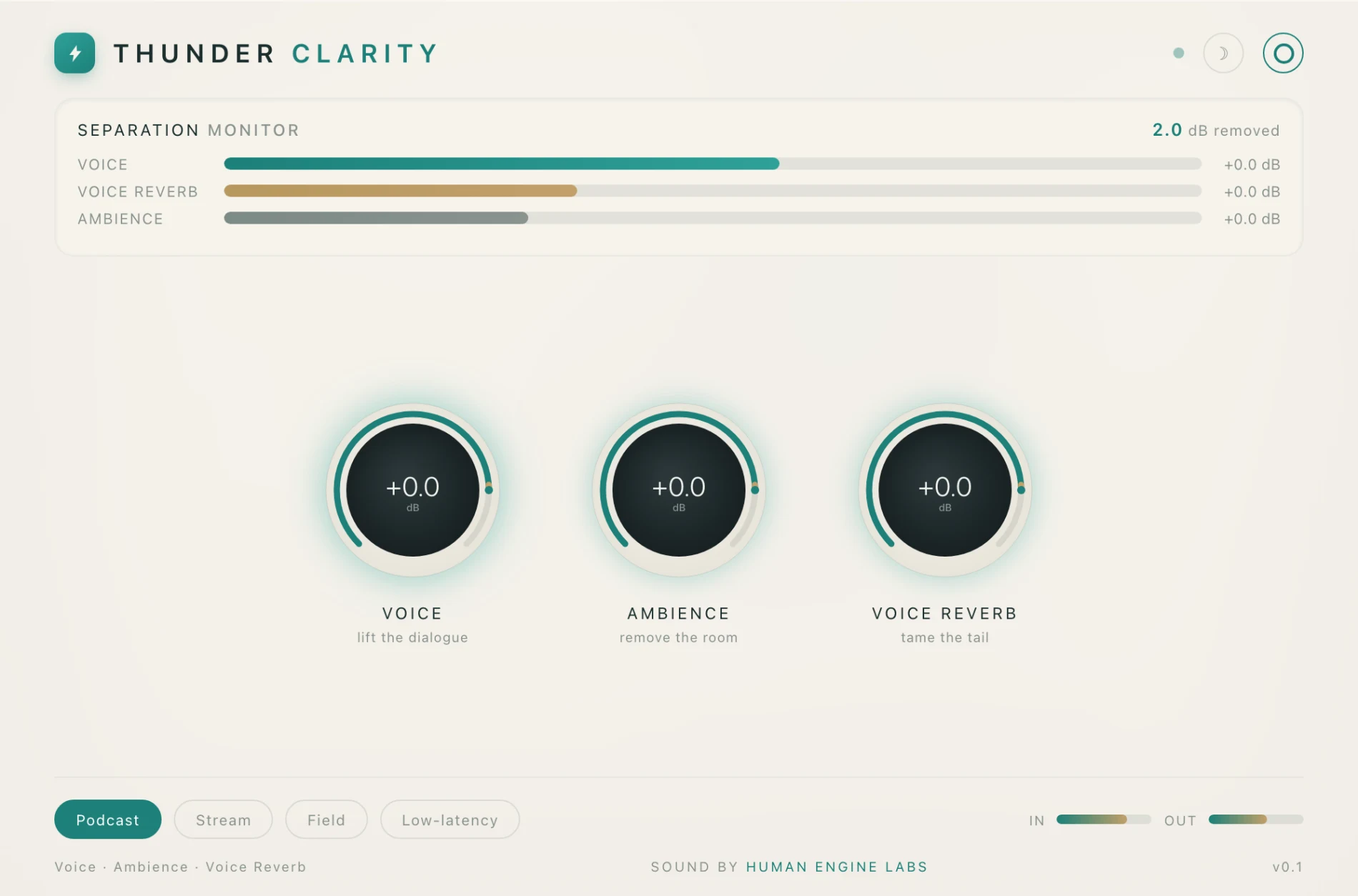
The three faders
Separate first. Then rebalance.
Noise gates and de-reverbs remove, and you hear the removal: pumping, gating, a voice that breathes in and out of a hole. Thunder Clarity removes nothing. Per STFT bin it splits the signal into voice, reverb tail, and ambience, reconstructs all three from the same frame, and lets you remix what came apart. The three stems sum back to the input at unity, so a fader is a balance, never a gate.
The separated dry voice. Push it up to bring dialogue forward. De-noising happens by lifting the voice, not by gating the noise.
The voice's own reverb tail, on its own fader. Pull it down to de-reverb a roomy take; push it up when the natural space is the point.
The room: traffic, hum, crowd, air. Pull it down to de-noise, or push it up to keep the scene and isolate the space instead.
The interactive separation demo opens when Thunder Clarity ships. Join the list to hear it first.
Join the listTwo engines
A fast one, and a deep one.
The same three faders, driven by whichever core the take needs. Pick per project. Both run in real time; both reconstruct to unity when you leave the faders flat.
Streaming STFT separator
A decision-directed Wiener split (the same a-priori-SNR estimator proven in Sibilance's denoiser, here full-band for voice isolation) running frame by frame with no model to load and no latency penalty.
A DFN3 model, inside the plugin
The full DeepFilterNet 3 core runs in real time at its native 48 kHz, joint de-noise and de-reverb, host-latency-compensated at a fixed 15 ms. When the classic path is not enough, this is the one that is.
DeepFilterNet (MIT / Apache-2.0) and RNNoise (BSD) are the openly-licensed cores we run; the stem-rebalancing DSP, the reverb and ambience split, the fault-tolerant host integration, and the plugin are ours. Attribution ships in the product.
A balance, never a gate
It removes nothing. It separates the voice from its room, and hands you a fader for each.
After the cleanup
It cleans, and it finishes.
Removing the room gets you a clean voice. Thunder Clarity keeps going. From the same signal chain, it delivers the parts you would otherwise need a mastering pass for.
One rule, any source
An adaptive six-band tonal matcher shapes the cleaned voice toward a studio target relative to its own tone: a boomy source is brightened, a thin one warmed, a dull one gains air, a harsh one is tamed. A consistency leveler rides phrase-to-phrase swings (a 12 dB swing lands near 4 dB) without touching note dynamics.
Know it will pass
Hit streaming and broadcast targets before you export: certify to −14, −16 or −23 LUFS with a true-peak meter that holds you under −1 dBTP. Underneath, a spec-exact ITU-R BS.1770 suite (short-term and gated integrated LUFS, 4× oversampled true-peak) at 48 kHz.
Compare like for like
Transparent bypass monitors the dry input scaled to the processed output's loudness. It uses a slow integrated-loudness match, so the dry take keeps its own dynamics and the comparison is the processing, not the level.
Presets & platforms
Built for where voices actually get recorded.
Four one-click starting points, each setting the full chain (separation, studio polish, leveling) for a real situation. Save your own; they persist across projects.
- Formats
- VST3 · Audio Unit · CLAP · Standalone, with a .pkg installer.
- Sample rates
- 44.1 / 48 / 96 kHz. The neural core is 48 kHz-native and says so rather than degrading silently.
- Fault tolerance
- The same aerospace patterns as Sibilance: a non-finite stem fails safe to dry, never to garbage.
- Works on
- Spoken and sung vocals. Built for streamers, post-production, podcasts and musicians.
- Stack
- JUCE 8 · C++20 · WebView UI over a C++/Rust engine.
Also in the works: a separate neural reverb stem, a lower-latency mode for live monitoring, and Studio Restore, an offline generative pass that rebuilds bandwidth a filter can only remove, regenerating a telephone-band clip out to 16 kHz.
Pricing
Not open yet.
Thunder Clarity isn't for sale yet. Sibilance opens first. When it does, it'll be perpetual: buy it once and it stays yours, with every future point release. Join the list and you'll hear the moment it opens, at the intro price.
- +Voice · ambience · reverb on three faders
- +Classic STFT and neural cores
- +Clean without gating the take apart
- +Studio polish and delivery metering
- +Adds Sibilance Pro for harsh consonants
- +Both instruments, perpetual
- +Every future point release