Fix harsh vocals without flattening the take.
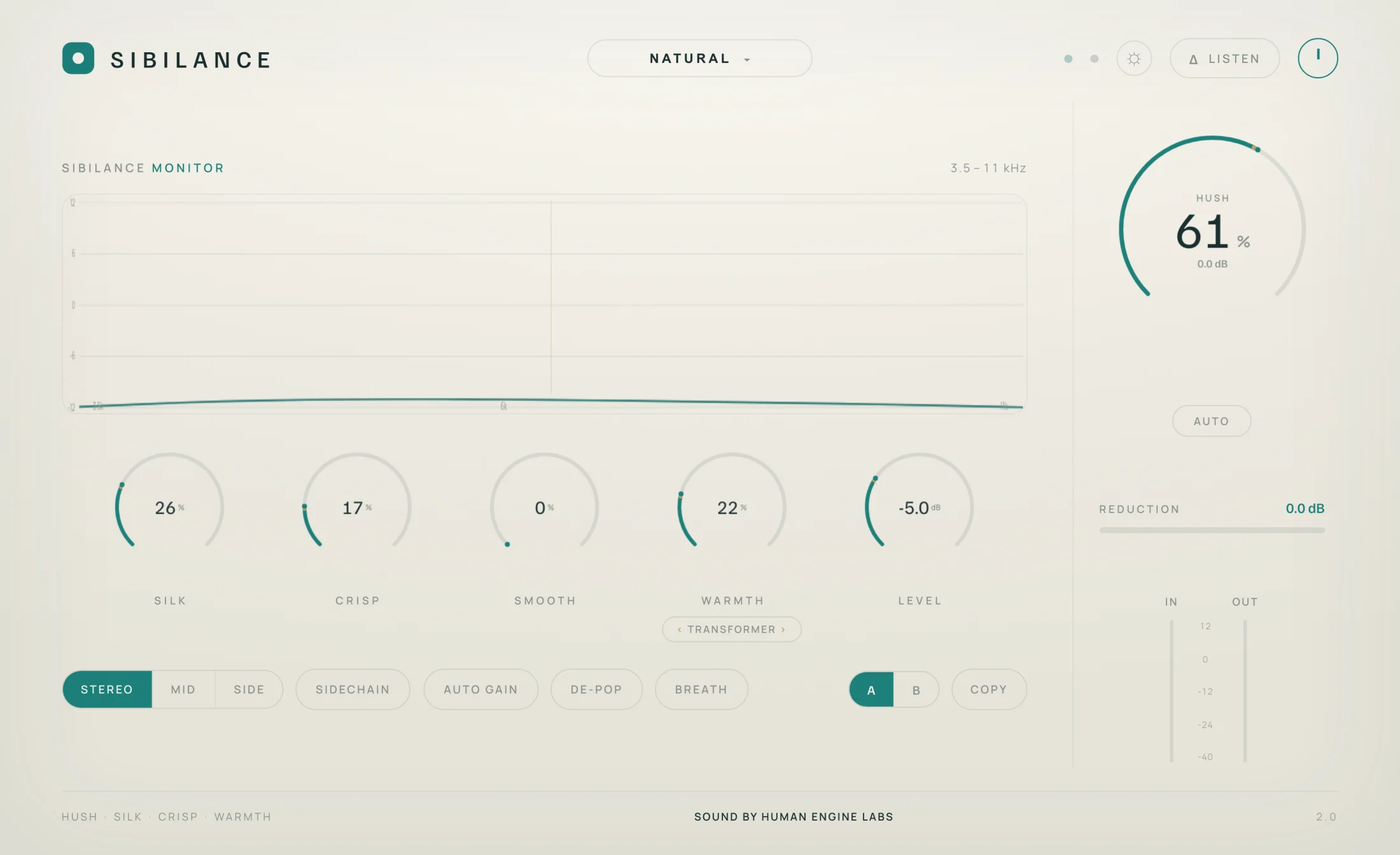
Sound builds adaptive audio plugins for vocals, dialogue, and voice recordings. Start with Sibilance: a de-esser that reduces the harsh consonant and leaves the rest of the performance intact.
The approach
Measure first. Move second.
The processor reads the signal before it acts, then keeps correction and character in separate stages. That gives you a small control surface without hiding what the engine is doing.
Analysis before movement
The detector reads what is in the signal before anything moves: consonant, voice, room, level, and time. The control surface stays small because the engine is doing the listening.
Character after correction
Saturation, air, and tone shaping sit after the cleanup stage. They add finish without putting harshness back into the part the processor just fixed.
Claims tied to tests
The site uses measured figures from real material and regression tests. If a number cannot be measured, it does not get promoted into a headline.
The Clarity Series
Two practical fixes for difficult vocals.
Use Sibilance when the vocal is sharp or spitty. Use Thunder Clarity when the room is in the recording. Both are built to solve one problem cleanly instead of covering the whole take in processing.
Sibilance
Built & validatedStop harsh esses without making the vocal dull. Sibilance finds the consonant, reduces only the sibilant band, and leaves the body and air where you mixed them.
Explore Sibilance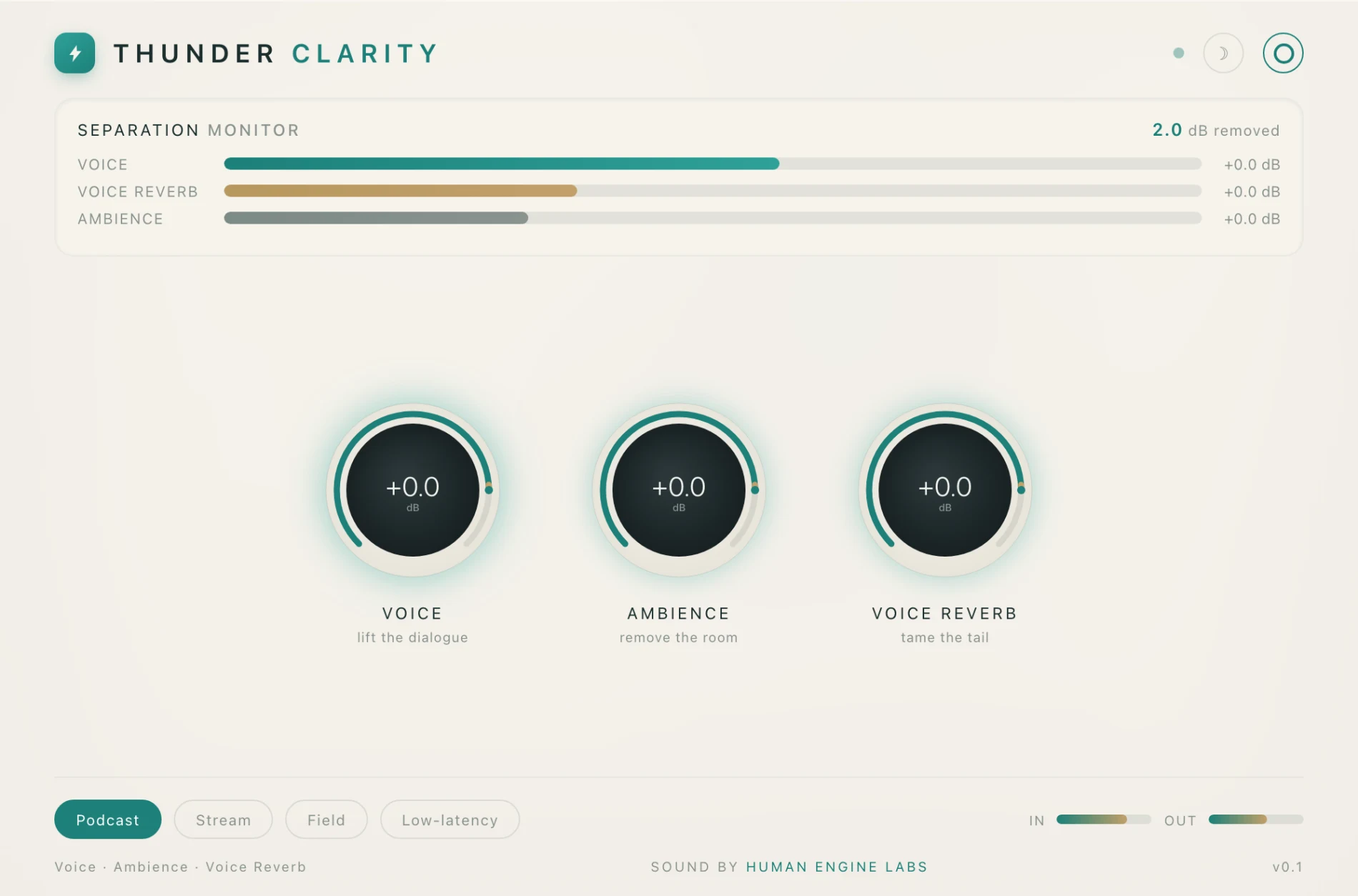
Thunder Clarity
Coming soonRescue voices recorded in bad rooms. Thunder Clarity separates voice, reverb, and ambience onto three faders so you can clean the take without gating it apart.
Explore Thunder ClarityValidation
Every number on this page is a measurement with a regression gate behind it.
The engineering
Three lanes. No lane decides alone.
The de-ess decision runs through three dissimilar lanes, the command-and-monitor pattern from flight-control computers. No single lane fault can cause a wrong cut.
Measures sibilant energy per block. Fast and deterministic, but it can’t tell an “s” from a plosive, so it never decides what a sound is.
Classifies the sound. It can veto the cut to protect a plosive or fricative, but it can never trigger one.
Requires the veto to hold across consecutive windows, so one wrong frame can’t trip protection or flash a false letter on the meter.
Validation
Measured on real vocals.
Validated end to end on real vocal recordings, not synthetic test signals, which would let us print kinder numbers than these.
Pricing
Try it before you buy it.
Start with the free commercial tier or unlock Sibilance Pro for seven days, no card. Paid licences are perpetual when checkout opens.
- +Core de-esser
- +Δ Listen · Auto Gain
- +Commercial sessions allowed
- +Full macro set + finish
- +Mid/Side, De-Lisp, sidechain
- +Presets and A/B
- +Voice · reverb · ambience
- +Classic + neural cores
- +Delivery metering
- +Sibilance Pro + Thunder Clarity
- +Future point releases
The list
Get the first installer.
Join for the Sibilance launch email, the first installer, and the intro price. No content drip, no general newsletter.
Release news only, unsubscribe any time. Privacy.
Release notes only.
Apple Silicon & Intel · JUCE 8 · C++20